chronology is hard
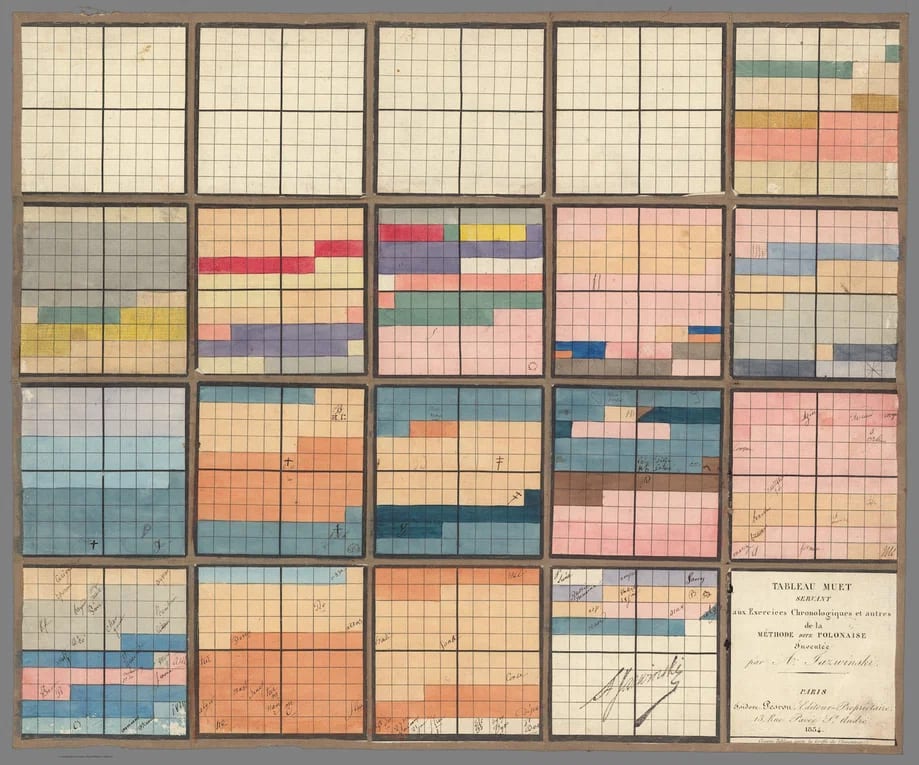
Via Flowing Data, The Public Domain Review on “The Polish System,” a grid system for visualizing a century’s worth of history:
The Polish System — which almost anticipates Piet Mondrian’s abstract checkerboards and the wider modernist fascination with grid figures — coupled chronology to the map-making traditions of geography. In Jażwiński’s original chart, each main 10x10 box is a century and the rows separate decades. Within a century box, each individual square is a year, each color a nation (with shading for different monarchs or governments), and symbols can stand for marriages, wars, treaties, and other types of events. Should one become proficient with this system, they can peer down on the history of the world, summarized on a surface not much larger than a chessboard.
This reminded me (like a lot of things do) of a post of Paul Ford’s, Unscroll Into, about his timelines project:
About fifteen years ago I had this idea: Timelines on the World Wide Web! Hardly an original idea. But I got super into it. I thought I could somehow fix the world a little by making a great website that organized things chronologically.
I did a ton of thinking about time. I learned a lot about how, for example, the Postgres database handles dates. I learned about different dating systems and calendars, and how various disciplines date things back to the beginning of the universe, and how the Library of Congress dates things. Chronology is hard. Time doesn’t lend itself to becoming data, no matter what the stock market tells you. … Nothing is more satisfying than learning about calendrical systems or the calculation of Easter. You feel how much people were stumbling in the dark, timewise.
Emphasis mine.
PS – Oh, and back in 2004 I was mucking around with the intersection of one-line blog entries and iCal files. Here’s the blog post, and here’s the archive.org snapshot of sippey.com/timeline (I should move that over here). “Calendars are not only planning tools, they’re rememberance agents.”